
Watch, learn and give your plants a good start. Choose a topic below for CUB Malaysia’s video demonstrations, practical steps and frequently asked questions.
Videos are in Bahasa Malaysia. Written guides and FAQs are in English.
More questions about your plants or order? Explore our FAQ & Plant Care hub →
Tanah Indoor
Our ready-to-use, airy mix for indoor plants and sheltered spaces such as covered porches and balconies. Leave space between the particles so air and water can move around the roots.
Repot with Tanah Indoor
Quick steps
1. Choose a clean pot with drainage holes, only slightly larger than the root ball.
2. Keep most of the existing root ball intact, especially for a newly purchased plant. Avoid removing too much old mix at once.
3. Fill gently around the roots with Tanah Indoor. No extra soil needs to be mixed in for normal use.
4. Water according to the plant’s needs, let excess drain, and check moisture before watering again.
Tanah Indoor FAQs
How is Tanah Indoor different from an aroid mix?
Both aim to give roots an open, airy growing environment. CUB Tanah Indoor is our ready-to-use option developed for indoor growing. Choose a mix and watering routine that suit the plant.
Which plants and spaces is it for?
Use it for suitable indoor plants, including plants kept under a covered porch or sheltered balcony. For flowering, fruiting plants and vegetables, we recommend Tanah Luar instead.
Do I need to mix it with other soil?
No. CUB Tanah Indoor is ready to use for repotting. A specialist plant may still need its own care routine.
Can I repot a newly purchased plant straight away?
Yes, while keeping most of the existing root ball intact. Do not remove too much old soil or disturb healthy roots unnecessarily.
Can I use it for flowering plants, fruiting plants or vegetables?
For these plants, CUB recommends Tanah Luar.
Can I use it for cacti and succulents?
Yes, CUB Tanah Indoor can be used. Choose a pot with drainage and allow an appropriate drying period for the plant; do not follow the same watering routine as a moisture-loving foliage plant.
Is the pack size measured by weight?
Pack sizes are measured by volume in litres, not by a fixed weight. Approximate references from CUB: 5L around 1.4kg+, 10L around 2.5kg+, and 30L around 7–8kg+. Moisture and packing can change the weight.
Tanah Luar
CUB’s recommended option for suitable outdoor plants, flowering plants, fruiting plants and vegetables. Check moisture more often in hot, sunny or windy conditions.
Repot with Tanah Luar
Quick steps
1. Use a clean container with drainage holes.
2. Position the plant at its previous planting depth and fill around the root ball gently.
3. Water evenly and let excess drain out.
4. Check the mix before the next watering. Rain, shade, sun and pot size change how quickly it dries.
Tanah Luar FAQs
Should I water outdoor pots every day?
Check the mix first. Pots in hot sun may dry faster, while shaded or rain-soaked pots may still be wet. Water based on moisture and the plant’s needs.
Can I use Tanah Luar indoors?
Match the mix to the plant and growing conditions. Indoor pots often dry more slowly. CUB Tanah Indoor is the option to consider for suitable indoor foliage plants.
Can I add pumice or Tanah Indoor?
You can adjust aeration for a particular plant when needed. Avoid changing the blend without considering its moisture needs, pot and location.
LECA / Bola Milo
LECA is lightweight expanded clay aggregate: clay balls that support roots in a soil-free setup. Choose the method that suits your plant and how often you can check it.
Step 1: prepare your LECA
Step 2: pot your plant
Choose the water level
CUB’s preparation method
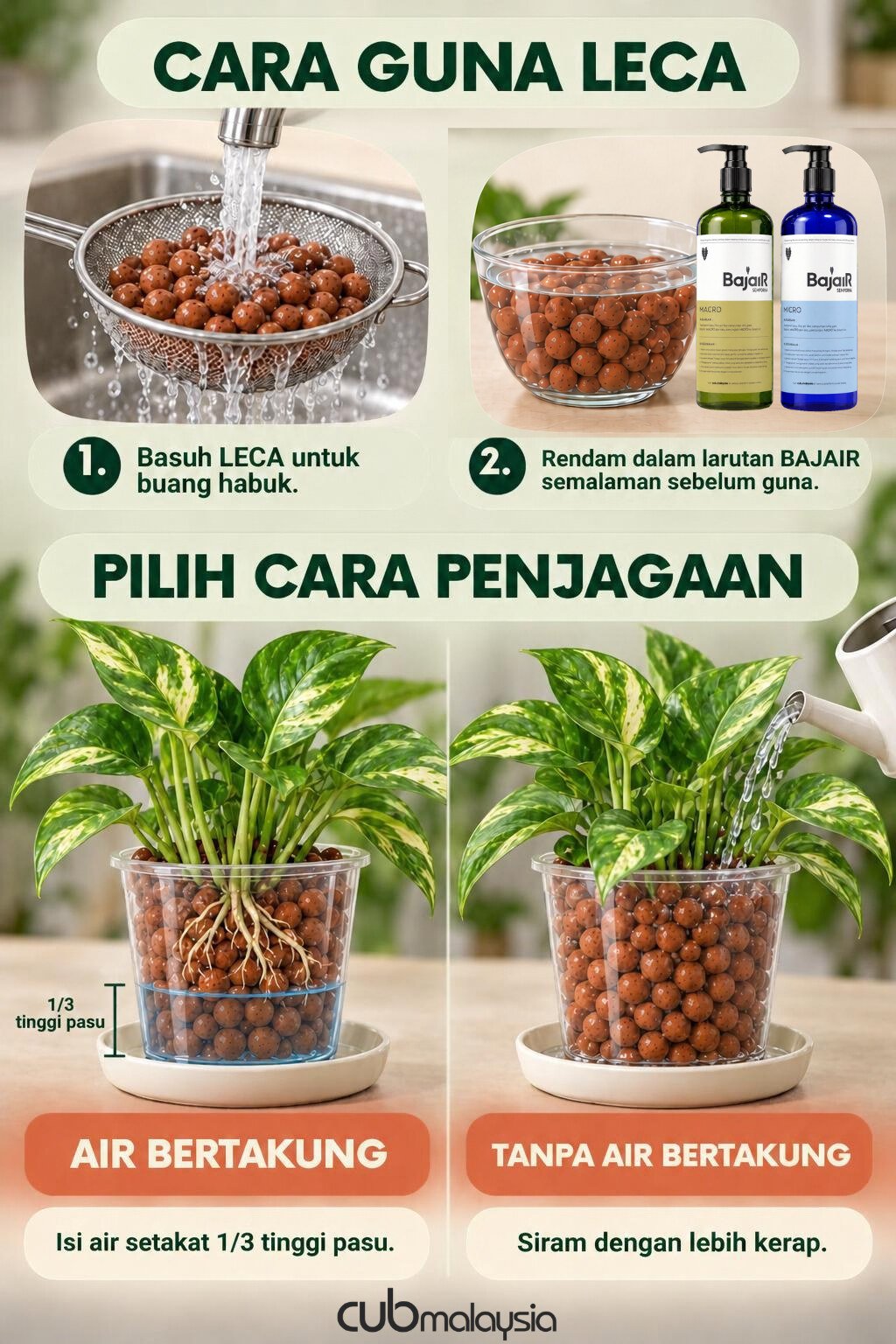
1. Rinse: wash away loose clay dust.
2. Soak: soak overnight in diluted Bajair Semporna, prepared at the bottle’s label dilution.
3. Pot: support the roots in LECA and keep the stem base above standing water.
Choose your watering method
With a reservoir: CUB’s starting guide is water up to about one-third of the pot height. Keep the crown and stem base above the water, monitor the plant and adjust for its roots and container.
Without a reservoir: water and drain, then check more often because there is no stored water at the bottom.
LECA FAQs
What is LECA made from?
Expanded clay. It can replace soil in a suitable setup and keeps the planting arrangement tidy. It still needs appropriate watering and nutrients.
Is LECA suitable if I travel often?
It can be useful once the plant is established in its setup. Check the water level and plant condition before travelling. Test how long your own reservoir lasts rather than assuming a fixed number of days.
Why does LECA grow algae?
Algae can grow where light reaches wet LECA or water. Use a tinted or opaque outer pot, or double-pot to reduce light reaching the reservoir, and clean it when needed.
How often must I replace LECA?
You do not need to replace it on a fixed schedule. CUB LECA is reusable; clean it before reuse, and remove damaged pieces or material affected by a plant-health problem.
What maintenance does LECA need?
CUB recommends flushing about once a month. Flush or clean sooner if you notice residue, algae, a bad smell or poor water quality. Inspect the roots if they become soft or mushy.
Can I use tap water only?
Plain water does not provide a complete long-term feeding routine. CUB recommends Bajair Semporna for the nutrient supply, used at the label dilution.
How do I prepare LECA before using it?
Rinse it first, then soak it overnight in diluted Bajair Semporna before potting. Use the bottle’s label dilution, not undiluted concentrate.
Is LECA sold by weight?
It is measured by volume in litres. Approximate CUB references: 1L around 0.5kg, 3L around 1kg+, 5L around 2kg+, and 10L around 4kg+. Moisture and packing can change the weight.
Rocksoil
Watch CUB’s Rocksoil repotting demonstration. Use the planting method and watering routine that suit your plant.
Repot with Rocksoil
Choose a pot with drainage, settle the roots gently, and check moisture before watering. Pair with Bajair Semporna at its label dilution when feeding is appropriate.
Watering
Learn to check the medium before reaching for the watering can. A fixed calendar cannot account for every pot, plant and location.
How to check when to water
Watering FAQs
How do I use a skewer to check the mix?
Insert a clean skewer gently into the mix without forcing it through roots, then inspect it. Damp material sticking to it suggests moisture remains. Combine this with pot weight and the plant’s needs.
Should I only check the top surface?
No. The surface may look dry while the lower root zone is still wet. Check below the surface and lift the pot before watering.
Should I leave water in a saucer?
For soil-grown plants, empty water collected after watering. A deliberate LECA reservoir is a different setup; follow the LECA guide for its water level.
Need help with a particular plant? WhatsApp CUB — 014-961 3929 (WhatsApp only).
Fertilizers & Bajair
Choose the relevant video below. Follow the current product label for dilution, dosage and frequency; different fertilizers have different uses.
Bajair Semporna
Fit the Bajair pump
Feeding and pump setup
Bajair Aquascape
CIRP
Dolomite
Osmocote
Can I use the same dose for every fertilizer?
No. Follow the label for the specific product and plant. Liquid feeds, slow-release granules and soil amendments are not interchangeable.
Need help? WhatsApp CUB — 014-961 3929 (WhatsApp only).